Forget what you’ve seen in the movies. The image of a shadowy figure in a trench coat is a world away from the reality of a modern UK Private Investigator. Today’s PIs are highly skilled professional fact-finders, brought in by individuals, solicitors, and businesses to gather information discreetly and, most importantly, legally.
They step in to bring clarity when the facts are murky, operating in areas where the police often can’t.
More Than Just a Hunch
So, what does a private investigator actually do? Think of them less as a vigilante and more as a specialist who uncovers verifiable information. Their work might be for a sensitive personal matter, a complex civil case, or a critical business decision. Everything they do is built on a foundation of diligence, discretion, and a deep understanding of UK law.
It’s crucial to understand that their role is entirely different from the police. While law enforcement deals with criminal matters, a PI’s world is the private and civil sphere. They’re the people you call to investigate a partner’s suspected infidelity, trace a debtor who has vanished, or conduct due diligence before a major corporate merger.
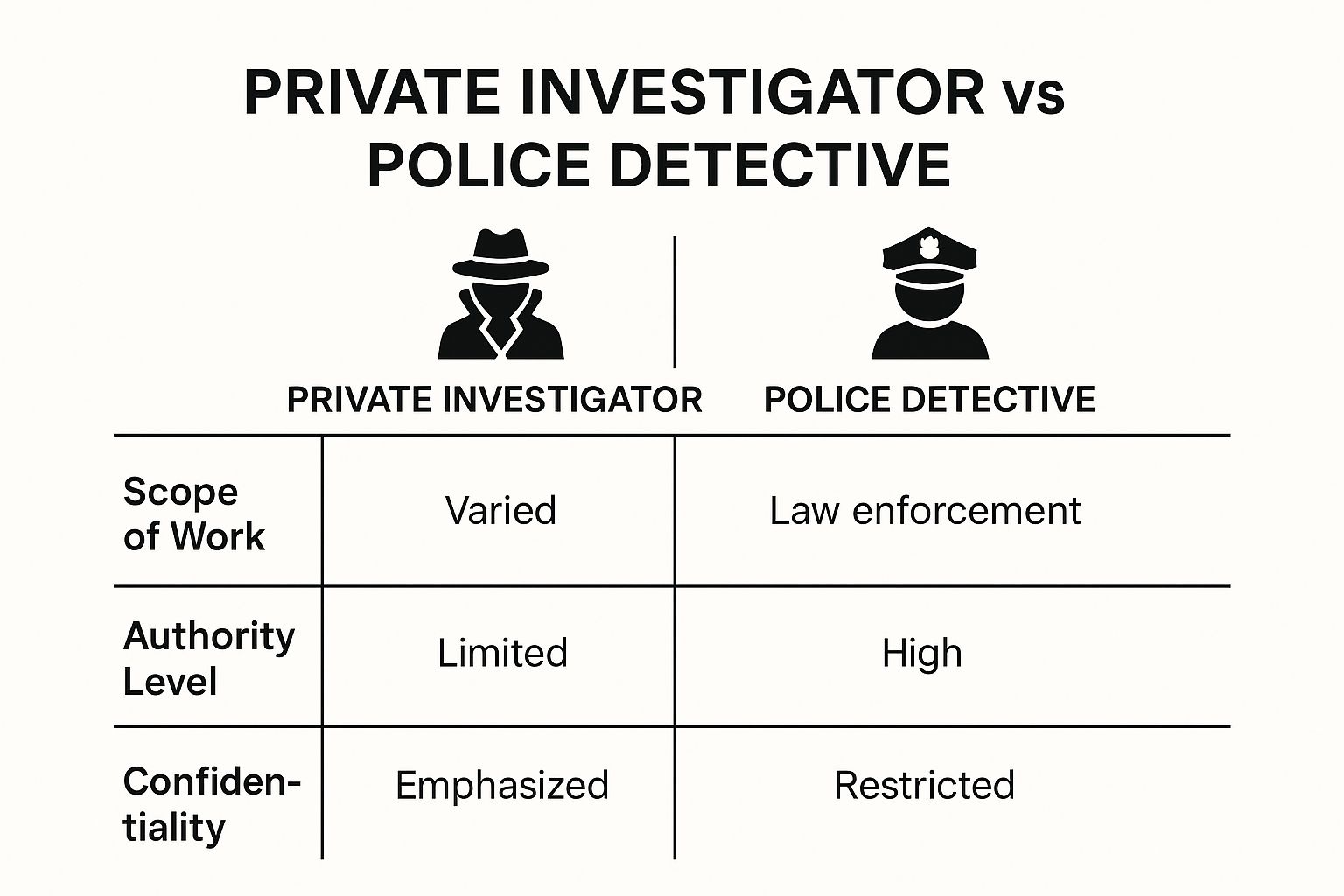
The key differences between a private investigator and a police officer are often a source of confusion. This quick comparison should help clear things up.
Private Investigator vs Police Officer At a Glance
| Aspect | Private Investigator (PI) | Police Officer |
|---|---|---|
| Jurisdiction | Works for private clients (individuals, businesses). | Works for the state; enforces public law. |
| Types of Cases | Primarily civil and personal matters (infidelity, fraud, background checks). | Criminal investigations (theft, assault, etc.). |
| Primary Objective | To gather evidence and information for a client’s specific needs. | To enforce the law, maintain public order, and bring criminals to justice. |
As you can see, a PI’s duty is to their client, not the state. They are focused entirely on achieving the objectives you set out for them.
A Commitment to Legal and Ethical Fact-Finding
There’s a common myth that investigators bend the rules to get results. The truth is quite the opposite. A reputable PI’s power comes from their skill in gathering information lawfully, not from operating in some legal grey area. Their day-to-day work is a blend of classic surveillance techniques, savvy digital research, and skilful interviewing.
A PI’s real value lies in knowing how to work effectively within the boundaries of the law to uncover the truth. They collect evidence that is not only revealing but also ethically sourced and, if needed, admissible in court.
To get those results, a modern investigator combines several key methods:
- Surveillance: This involves discreetly observing people or places to document their activities, often using high-definition video and photography.
- Open-Source Intelligence (OSINT): A fancy term for expertly sifting through publicly available data—from social media and news archives to public records—to piece together a complete picture.
- Interviews and Enquiries: Simply talking to people. A skilled investigator knows how to speak with relevant parties to gather firsthand accounts and verify other information.
This toolkit of skills allows them to handle even the most complex and sensitive situations with confidence. If you’re curious to learn more about what the job entails, you can get a behind-the-scenes look by reading our guide on the daily life of a private investigator. At the end of the day, their job is simple: to deliver the facts you need.
Are Private Investigators Legal in the UK?
It’s one of the first questions on everyone’s mind, and the answer is a simple, resounding yes. Private investigation is perfectly legal here in the UK. But, and it’s a big but, the industry operates in a bit of a grey area when it comes to regulation.
You see, unlike a security guard or other similar roles, private investigators aren’t required to have a government licence to operate. This puts the responsibility squarely on your shoulders to find someone who is not only effective but also ethical. A professional investigator has to be a master of navigating a complex legal maze, including the Data Protection Act 2018, GDPR, and the Human Rights Act.

This legal framework is precisely what separates the professionals from the cowboys. A legitimate PI gets results through skill and knowledge, not by cutting corners or breaking the law. Knowing where those boundaries lie is the first step to hiring someone you can truly trust.
What a Private Investigator Cannot Legally Do
To really understand what a PI does, it helps to first know what they absolutely cannot do. There are firm legal and ethical lines in the sand that prevent them from straying into criminal activity to get the answers you need.
- Impersonate Law Enforcement: They can never pretend to be a police officer, a government agent, or any other official.
- Hack into Accounts: Illegally accessing someone’s emails, social media profiles, or bank accounts is a serious crime.
- Trespass on Private Property: They cannot simply walk onto private land or enter a home without permission.
- Obtain Private Records Illegally: A PI can’t use deception or illegal means to get protected data like phone bills or medical records.
A professional investigator’s value is in their ability to gather intelligence within the confines of the law. Their expertise lies in finding the facts through legitimate means, like surveillance and deep-diving into public records, making sure any evidence they uncover is ethically sound.
The lack of a formal licensing system hasn’t stopped the industry from growing. In fact, it’s thriving. The UK private investigation sector is projected to be worth a staggering £520 million by 2025, a clear sign of just how much demand there is.
This growth makes it even more crucial to choose an investigator who holds themselves to a higher standard. A great way to do this is to check their credentials. Are they a member of any respected UK professional bodies for investigators? These organisations demand that their members stick to a strict code of conduct, giving you peace of mind that you’re hiring a true professional.
What Services Do Private Investigators Offer?
A private investigator’s work is incredibly varied. They’re not just one-trick ponies; think of them as problem-solvers with a specialised toolkit for digging up information that’s hard to find. Their services are designed to bring clarity to complex situations, whether it’s a deeply personal family issue or a high-stakes corporate dispute. At its core, their job is to gather verifiable facts.

For individuals, hiring a PI often happens during stressful, emotional times when getting to the truth is the only way forward. For businesses, it’s about protecting their assets, their people, and their reputation from threats that aren’t always visible on the surface.
Services for Personal Matters
When something feels wrong in your personal life, a private investigator can be the one to provide the hard evidence you need to move on. Their skills are surprisingly versatile and can be applied to some of life’s most challenging moments.
Here are a few common requests from private clients:
- Infidelity Investigations: This is perhaps what PIs are most known for. If you suspect a partner is being unfaithful, an investigator can use discreet surveillance to find out for sure, providing photographic or video evidence that leaves no room for doubt.
- Finding Missing People: It’s not always about drama. Sometimes you just want to find an old school friend, a long-lost relative, or even someone who owes you money and has disappeared. PIs have access to powerful databases and tracing methods that the general public doesn’t.
- Background Checks: Before you let someone new into your life or trust them with your children, a background check can be invaluable. It can confirm someone’s identity, check for a criminal past, and verify their history, giving you complete peace of mind.
Services for Corporate and Business Clients
In the business world, a private investigator is a powerful ally against both internal and external risks. They’re the secret weapon companies use to operate safely, protect their interests, and make decisions based on facts, not just feelings.
For a business, a PI is all about safeguarding assets and integrity. They deliver the factual grounding needed to take decisive action, whether that means firing a fraudulent employee, taking a competitor to court, or pulling out of a risky business deal.
Corporate services are often focused on preventing losses and gathering evidence for legal proceedings. This might involve looking into employee theft, catching someone making a fraudulent sick leave claim, or conducting due diligence on a potential business partner to uncover hidden debts or reputational damage. They are also crucial in the fight against intellectual property theft, helping to protect a company’s valuable ideas and financial health.
Ultimately, by offering these bespoke services, a good PI delivers the truth that empowers their clients. To see the full scope of what’s possible, you can explore our complete list of private investigator services in the UK.
Inside the Modern Investigator’s Toolkit
Forget the old clichés of magnifying glasses and trench coats. Today’s private investigator blends time-honoured field skills with some seriously powerful technology. The modern PI is just as comfortable on a covert surveillance operation as they are digging through digital data streams.
This dual approach is what gets results. While classic on-the-ground observation is still vital, it’s now amplified by discreet cameras, audio recorders, and other bits of kit that capture the facts without anyone being the wiser. But the real shift? That’s happened online.
From Footwork to Finger Taps
A massive part of any modern investigation is what we call Open-Source Intelligence (OSINT). Think of it as the art of finding needles in a giant, public haystack. A skilled investigator knows exactly how to sift through social media, property records, company filings, and news archives to piece together a coherent story.
To do this efficiently, many of us use specialized research platforms to pull all that data together. It helps connect dots that aren’t obvious, giving clients a clear, evidence-based picture of what’s really going on.
The difference this makes is huge. We’ve seen digital evidence collection boost case success rates by as much as 43%, and it often gets the job done faster.
Using Technology Legally and Ethically
Having all this tech is one thing; knowing how to use it legally is another entirely. A true professional operates strictly within UK law, ensuring any evidence they uncover will stand up when it matters.
The real skill of a modern PI isn’t just using the latest gadget, but knowing precisely how and when to apply it within legal boundaries to find the truth. Their value comes from delivering verifiable facts, not from breaking rules.
This means a PI has to be an expert on the finer points of privacy and data protection. For example:
- GPS Tracking: An investigator can legally put a tracker on a company van to check if an employee is misusing it for personal errands. They can’t, however, put one on a personal car without consent.
- Digital Forensics: In a corporate fraud case, a PI can recover deleted files from a company-owned laptop. They absolutely cannot hack into someone’s personal phone or computer.
This meticulous, lawful approach ensures every piece of information is obtained correctly. It protects the client, the investigator, and the integrity of the whole case.
How to Hire a Private Investigator You Can Trust
Taking that first step to hire a private investigator can feel daunting, a bit like stepping into a whole new world. But finding a credible, professional PI is actually quite straightforward once you know what to look for.
In the UK, the industry isn’t subject to mandatory government licensing. That means the onus is on you, the client, to do your homework. A genuinely trustworthy investigator will be transparent and professional right from the very first phone call.
Your mission is to find someone who not only has the skills to get the job done but also operates within the bounds of the law, always acting ethically on your behalf. Think of it like hiring any other professional service.
Your Vetting Checklist
Before you sign on the dotted line, it’s worth running through a few essential checks. These simple steps will help you weed out the unprofessional operators and give you real confidence in the person you choose. Any genuine pro will be happy to answer your questions.
Here are the non-negotiables:
- Professional Memberships: Check if they belong to a recognised body like the Association of British Investigators (ABI). Membership isn’t just a badge; it means they’ve agreed to a strict code of ethics.
- Insurance Verification: Don’t be shy about asking for proof of their professional indemnity insurance. It’s a crucial safety net that protects both you and them if anything goes awry.
- Testimonials and Reviews: What are past clients saying? Look for genuine feedback on their website or independent review sites. A good track record speaks volumes.
- Clear Communication: A professional website, a proper business address, and a landline number are all good signs of an established, legitimate operation.
Your initial consultation is the best test. It should always be confidential and free of charge. You should walk away with a clear idea of their plan, the likely costs, and what they realistically think they can achieve.
What to Expect After You Hire Them
Once you’ve made your choice, the whole process should feel clear and structured. Remember, you’re the client—you should feel informed and in control from start to finish.
Typically, things will follow a clear path. You’ll start with a detailed chat to pin down the exact goals of the investigation. After that, you should get a written contract or agreement that clearly lays out the scope of the work and the fees you’ve agreed to.
As the investigation unfolds, you should receive regular progress updates. When it’s all wrapped up, you’ll be given a comprehensive report detailing all of their findings, backed up by any evidence they’ve gathered, like documents or photographs. This final report is the concrete result of your investment.
What Does a Private Investigator Actually Cost?
When you decide to hire a private investigator, you’re really investing in getting answers. The first question on most people’s minds is, “How much will this cost?” There isn’t a one-size-fits-all answer, because the pricing is tailored to what your specific situation demands. This way, you’re only paying for the time and skills needed to get the job done right.
In the UK, most professional investigators will structure their fees in one of three ways. This gives them the flexibility to handle everything from a few hours of observation to a deep-dive investigation that might take weeks.
How Investigators Charge for Their Time
The type of work you need doing will almost always dictate how the bill is calculated. Here’s a look at the most common pricing models you’ll come across:
- Hourly Rates: This is the go-to model for jobs where the timeline is a bit unpredictable, like surveillance or digging through records. You pay for the time spent, plain and simple.
- Daily Retainers: If you need an investigator dedicated to your case for a full day or more, a flat daily rate often works out better value than paying by the hour.
- Fixed-Fee Packages: For clear-cut tasks with a predictable process—think a standard background check or finding a specific person—many firms will offer a single, all-in price.
Always make sure you get a written agreement before any work starts. It should spell out exactly what you’re paying for, the objectives of the investigation, and any potential extras like travel expenses. This simple step prevents any nasty surprises down the line.
Ultimately, the final bill depends on the complexity of the job. A case that needs a team of investigators, specialist equipment, or work in a city like London is naturally going to cost more than a straightforward local query. In 2025, you can expect to see private investigator fees in the UK typically falling between £300 and £1,000 per day, depending on the case and the investigator’s experience. For a deeper dive, you can find a comprehensive breakdown of private investigator costs. What you’re really paying for is expertise, discretion, and the peace of mind that comes with solid, verifiable facts.
Your Questions About Private Investigators Answered
To wrap things up, let’s tackle a few of the most common questions people ask before bringing a private investigator on board. Getting these points clarified should help you feel more confident about taking the next step.
Is My Consultation Confidential?
Absolutely. Confidentiality is the bedrock of this profession. From the very first phone call, everything you share is held in the strictest confidence. Reputable investigators are legally bound by stringent data protection laws like GDPR, so you can be sure every detail of your case remains completely private. Think of that initial consultation as a secure space to lay out your concerns, with no obligation.
Can a PI Get Phone Records or Bank Statements?
This is a persistent myth, likely fuelled by films and TV shows. The simple answer is no. A private investigator in the UK cannot legally access protected personal data like phone bills, bank statements, or medical files without the subject’s consent or a court order. Attempting to do so is a serious breach of privacy laws, and no true professional would ever risk their career by crossing that line.
At the end of an investigation, you will receive a professional, detailed report. This document outlines the objectives, methods used, a timeline of activities, and all evidence gathered, such as dated photographs, video footage, or documents compiled to be clear and admissible in court if required.
What Kind of Report Do I Get?
Once the fieldwork is complete, you’ll receive a comprehensive, professional report. This isn’t just a simple summary; it’s a detailed document that clearly outlines the initial objectives, the methods used to gather information, and a timeline of all activities. Most importantly, it will include all the evidence collected, presented in a clear, factual way that’s easy to understand.
If you need discreet, professional help to find the answers you’re looking for, the team at UK Private Investigators is ready to assist. With decades of experience, we provide the clarity you need to move forward. Contact us today for a confidential consultation.